Only your org and invited staff log in here.
Players, parents, coaches & officials.
We support 30+ sports and keep adding more.

“Sports organization” covers a volunteer-run rec league of ninety children and a regional association with forty member clubs, and they do not want the same thing. What they share is the shape of the work — take sign-ups, collect money, put people into teams, schedule something, tell everyone when it changes — and that is what Ligue is built around, at whatever size you run it.
A league’s whole year is registration, divisions, a fixture list and a table that has to stay honest. Ligue takes the sign-ups and the fees, places athletes into divisions, schedules against your venues, and recalculates the standings from results — so the committee spends its evenings on the season rather than on a spreadsheet.
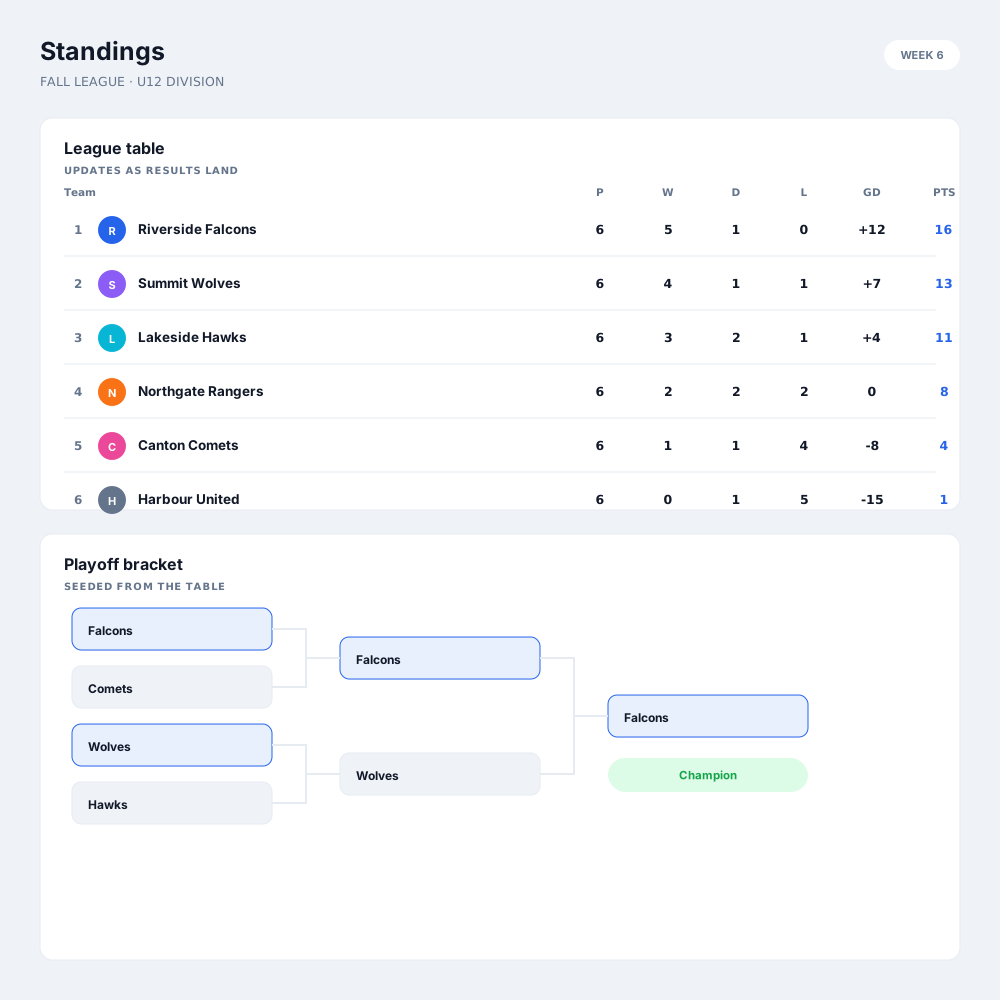
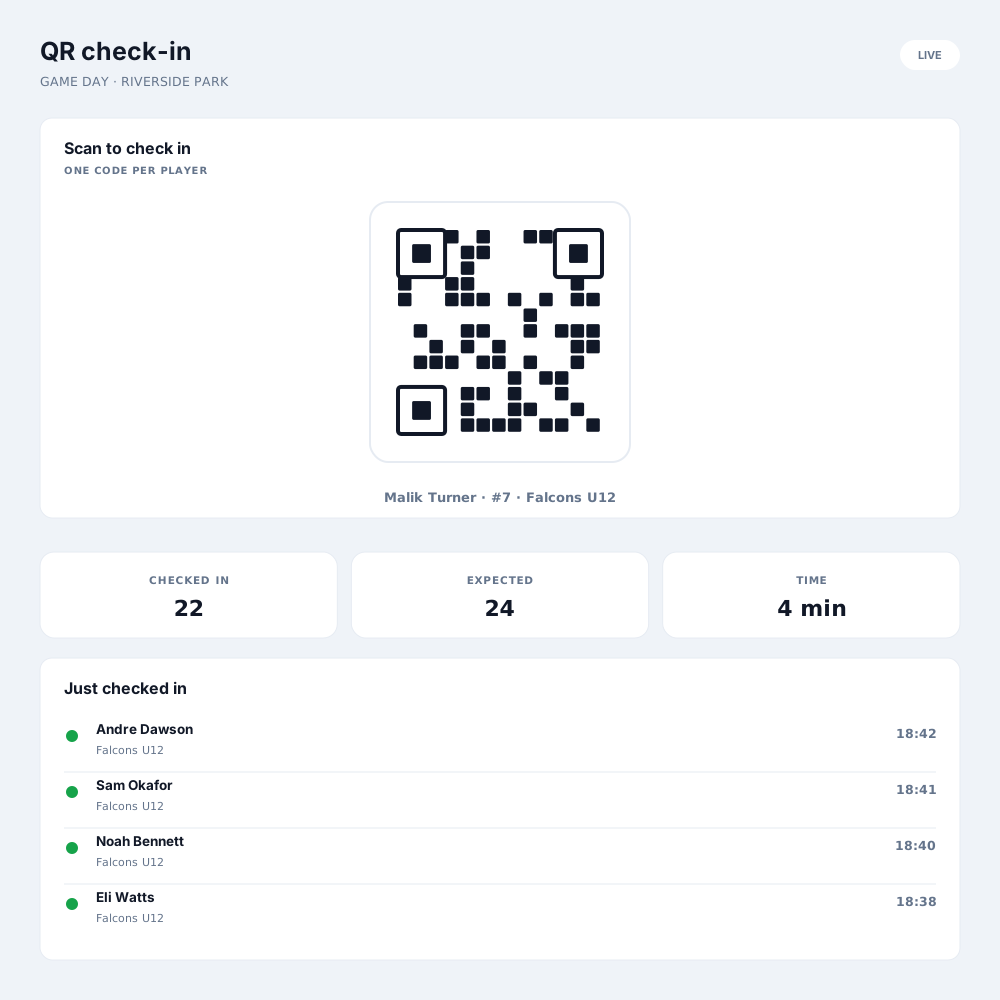
Tournament directors live and die by a single weekend. Team entries and deposits up front, a bracket seeded from your standings or set by hand, check-in by scan at the gate, and a running order across every venue — with the draw advancing as results land rather than being redrawn between rounds.
Clubs are the awkward middle: several teams, several age groups, often several sports, and a committee that changes every two years. One organization holds all of it, with staff permissions that survive a handover and reporting that shows which parts of the club actually pay for themselves.
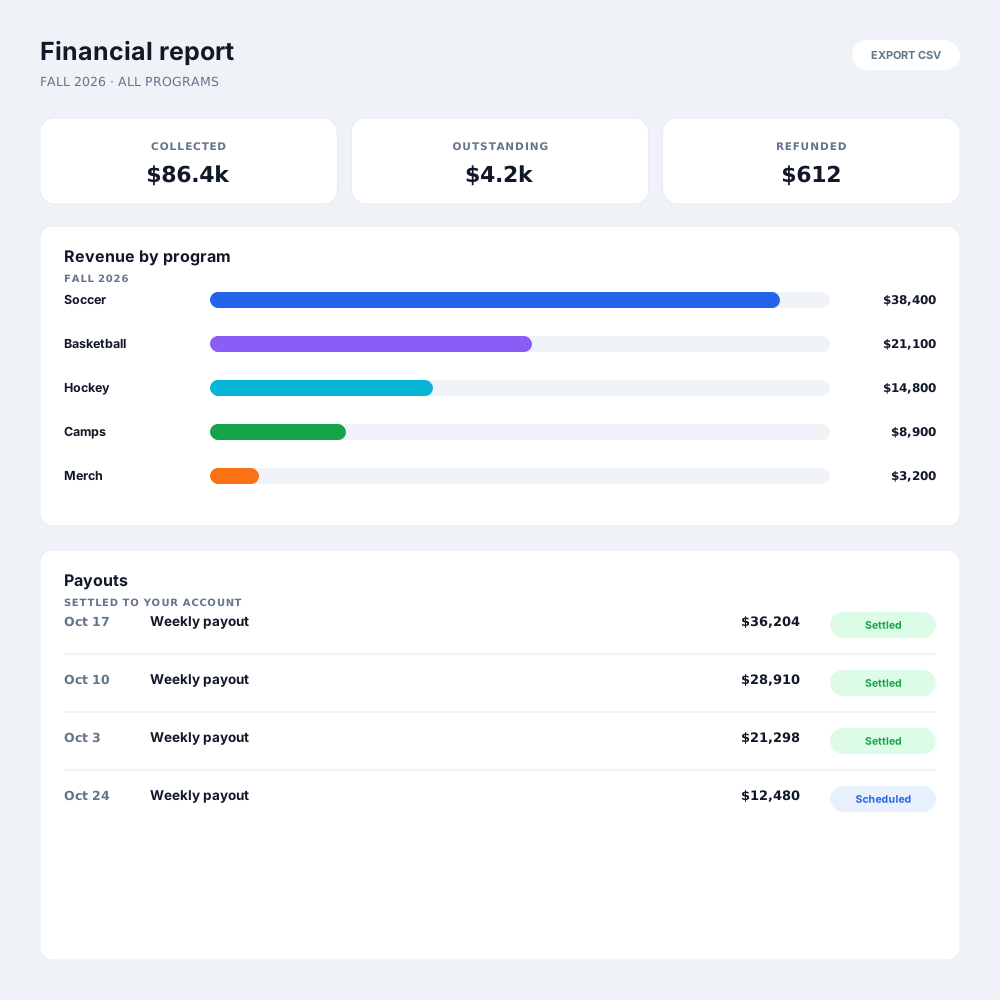
Academies are subscription businesses with a training timetable attached. Recurring dues run on a schedule, the weekly timetable rolls term to term, and attendance becomes the progress record a year-round paying parent will eventually ask you about.
Camps and clinics compress a season into a week, so the pressure lands on sign-up capacity, staffing ratios and knowing who is on site at any moment. Short forms, instalments, staff assignments and check-in by scan are what make a Monday drop-off work.
Youth organizations carry obligations the others do not — waivers and medical information on file, background checks on every adult, and a duty of care you may have to demonstrate. Those sit on the same records as the rosters rather than in a filing cabinet somebody has to go and find.
Associations sit above member organizations and need both views at once: each member running itself day to day, and the association seeing participation, competition and revenue across the whole region without asking forty administrators for forty exports.
The software question is different at ninety athletes than at nine hundred, and the transition is where most organizations get stuck.
Everything is in somebody’s head and mostly that works. What hurts is collecting money and chasing forms, so registration and payments are the whole win. You do not need reporting yet.
The point where one person can no longer hold it. Work has to be delegated to coaches and managers without handing over the finances, which is when roles and permissions stop being a nice idea and start being the thing that lets you sleep.
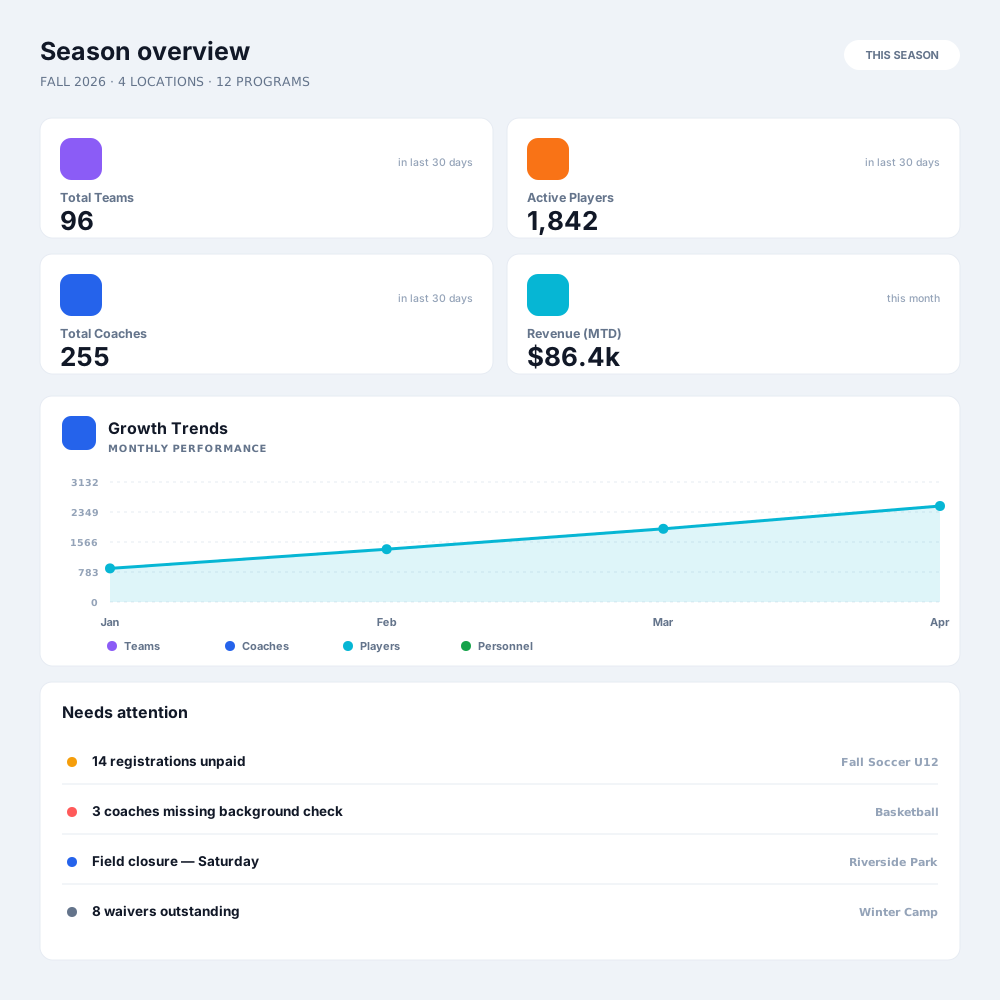
Now the questions are strategic: which programmes pay for themselves, is retention improving, did the second site work. Those are comparisons, and they need every sport and site in one system to be answerable at all.
Local administrators run their own site or club while the organization sees across all of them, from the same underlying data so the two can never disagree.
No. The same platform runs a ninety-child rec league and a regional association — pricing is $100 per sport per month with unlimited players and teams, so a small organization is not paying for scale it does not have.
Yes, and that is a design constraint rather than an afterthought. Scorekeeping, check-in and attendance are done from a phone by whoever is there, and permissions let you give a volunteer exactly one job without handing over the organization.
Access is by role, so handing over is a matter of inviting the new treasurer and removing the old one. The organization’s data, history and records stay put rather than leaving with whoever owned the spreadsheet.
Yes. Multiple sports and multiple locations sit inside one organization, each managed locally, with reporting that rolls up across the whole thing.
No. They are one system, which is the point — a completed registration becomes a roster becomes a team sheet becomes a result without anything being exported and re-imported.
Members run themselves day to day while the association gets participation, competition and revenue across the region from the same data, rather than collecting exports from every club.
Register in minutes, or book a walkthrough and we'll tailor it to the way you already run things.